
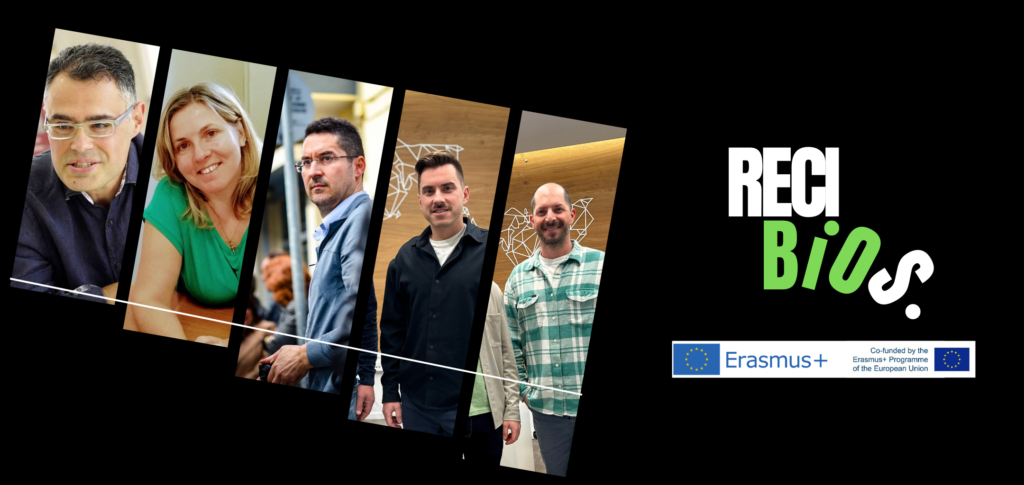
The new Erasmus+ program in Naoussa, entitled “RECIBIOS: Challenge-based experimentation on BIOdegradable RECIpeS in lower secondary education,” which is co-funded by the Erasmus+ program, has officially begun.
The “RECIBIOS” Program focuses on educating middle school students on the concepts of bioeconomy and circular economy with the aim of inspiring students to become advocates for greener future development.
By incorporating the principles of the circular economy and bioeconomy into secondary education, the program aims to:
- Develop students’ “green” skills,
- Encourage students to deepen their knowledge of sustainable development,
- Help students understand the world around them based on the principles of the circular economy.
PROGRAM DESCRIPTION
Can you imagine a school classroom where fruit scraps and other organic waste are not thrown away in trash cans, but are converted into valuable and environmentally friendly materials?
The RECIBIOS program aims to clarify the concepts of bio and the circular economy to students by introducing them to the thinking behind the process of creating biodegradable materials, while inspiring them to pursue a future career path based on sustainability.
Understanding materials, how they are created, used, and discarded, are valuable skills in a world that produces and consumes uncontrollably. The RECIBIOS program will introduce students to the circular way of thinking, where materials are by definition sustainable and biodegradable, moving away from the traditional model of production-use-disposal.
EXPECTED RESULTS
- Learning through interactive activities. Students will be asked to tackle real-life challenges that will encourage them to think critically and solve problems creatively using biomaterials.
- Practical experience. The program includes activities involving experimentation with natural materials and understanding their components.
- Learning from others: As part of the Program, student exchanges will take place between Greece and Belgium, where participants will interact and engage in discussions on global challenges related to sustainable development.
PARTNERS
- RHIZO High School, Belgium, lead partner, with extensive experience in innovative learning methods, which will ensure that the educational material is developed to high educational standards.
- 1st Gymnasium of Naoussa, Lappio, with a strong interest in environmental education, will implement the educational program in Greece and participate in student exchanges between Greece and Belgium.
- EduQuest, a non-profit organization based in Naoussa, will contribute to the creation of educational material, the search for good practices, and the publicity of the program in Greece and abroad.
PARTNERS
- The Naoussa Robotics Academy will use the results produced through the Program to enrich its educational program with new teaching materials based on sustainability.
INFORMATION
For more information, please contact us at info@eduquest.gr and visit our website at www.eduquest.gr.